On America’s Middle Passage
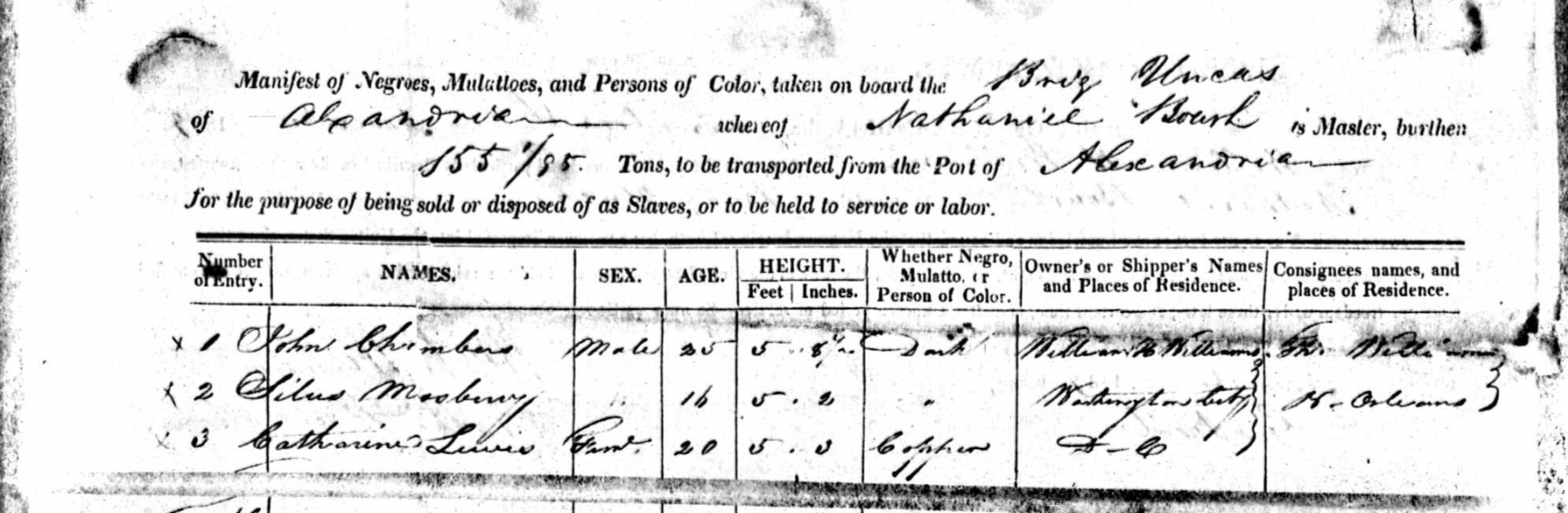
Manifest of the Uncas (1839), as cited in the Oceans of Kinfolk database.
The following is an excerpt from my book, Oceans of Kinfolk: African American Ancestral History and the Antebellum Coastwise Traffic of Enslaved Persons to New Orleans, forthcoming from UNC Press.
On the last day of May in 1938, Rebecca Brown Hill received a visit from a white woman who said she wanted to ask Hill about her memories of slavery. The woman’s name was Irene Robertson, and she was one of several dozen people, mostly white southerners, who had been hired by the federal Works Progress Administration to conduct interviews of individuals, like Hill, who had been enslaved before the Civil War. By the end of Robertson’s visit, Hill had provided four pages worth of testimony.
As she told her interviewer, Rebecca Brown Hill was born to enslaved parents on October 18, 1859 in Chickasaw County, Mississippi, but her generation was the first in her family born in the Deep South. Hill’s maternal grandmother, a woman named Harriet, was born in Baltimore. According to her granddaughter, Harriet’s enslaver was a “white Choctaw Indian” named John Abbott, a cooper by trade. Harriet ultimately bore at least two children by this man, a son whose name Hill did not share, and a daughter named Catherine. After the birth of her two children, though, Abbott sold Harriet away, married a white woman, and built a new, white family, one his enslaved children were required to serve. Around the same time, Abbott relocated to Washington, D.C., forcing Catherine and her brother to come with him.
After the sale of her mother, Catherine suffered another severe loss when her brother tragically died. According to Hill, Catherine’s brother had “run off and was leaving on a ship on the Potomac River” when he fell overboard and drowned. His body was discovered sometime afterwards as workers fished for a woman’s trunk that had also fallen into the sea. With her brother gone, Catherine, likely in her teens, was left to wait on her father/enslaver and his white family alone. Until this point, Hill reported, Catherine had always had “long straight black hair,” but once she was the only enslaved person in the household, her enslavers chopped it off. Catherine felt this assault deeply. “They cut her hair off,” her daughter told Irene Robertson, “she hated that.”
As a young enslaved woman forced to wait on her white kin alone, Catherine must have been extremely lonely. So, she sought company where she could find it. According to Hill, Catherine began visiting a nearby “trader’s yard” in order to “talk and laugh” with people she knew there. Catherine surely knew this was a dangerous place to visit, for traders did not just buy and sell people whom they acquired through legal means. They kidnapped people, too, both free and enslaved. For this reason, Catherine was always careful to bring a basket or a bucket with her when she went to the trader’s yard. That way, she figured, would-be kidnappers would assume she had been sent on an errand by her enslavers.
From Hill’s interview, it is difficult to tell how it happened—whether the trader stole Catherine by simply kidnapping her off the streets, or if, instead, he had her arrested as a supposed fugitive from slavery. Either way, he stole her, and then he sent her to New Orleans. Catherine Lewis never set foot in the Chesapeake again.
Once he had Catherine in New Orleans, the trader had a decision to make. On the one hand, he could try to sell her just like he would everyone else on the ship. The trouble with that plan, though, was that buyers usually wanted to see some sort of proof of ownership before they would fork over their money, and since he had stolen Catherine Lewis, he had no papers for her at all. Of course, the trader would still be able to sell her without papers, but most likely for a reduced price. This, the trader decided, would not do. So he came up with another plan.
Over the course of the voyage, Catherine Lewis had grown quite attached to one of her fellow captives, a man named Jacob Brown. This, the trader realized, could be quite useful indeed. Yes, a buyer with any sense at all would want to see Catherine’s papers, but folks were rarely so persnickety about temporary arrangements. So, first things first, the trader struck up a deal; he hired Jacob Brown out to a man from Alabama. Then, turning to Catherine, he must have said something like this:
I’m a kind man. What do you say I hire you out along with Jacob?
Catherine, of course, would have known that she was not the trader’s to sell or hire out–not legally, anyway. Asserting this fact, however, was unlikely to bring her anything but a beating, after which the trader would surely sell or hire her out anyway, only without Jacob. So it was that Catherine Lewis and Jacob Brown ended up in Chambers County, Alabama, together.
In Alabama, Catherine and Jacob were not free, but they had each other. And then, before long, they had a child, too: a baby boy they named Henry. A daughter, Hannah, followed soon after.
Then, however, the trader showed up in Chambers County, looking to cash in on the “investments” he had stashed there two years prior. And this time, the man was not interested in making any temporary arrangements. He was determined to sell the whole family. With papers for Jacob and the two children on hand, perhaps he doubted that anyone would make a fuss about his having “misplaced” Catherine’s papers…unless, that is, Catherine made a fuss herself. That she would do so was possible, the trader must have figured, but it could be avoided, because, just like before, he had a plan. And so, yet again, the trader must have asked Catherine a question, one that probably went something like this:
Do you want to be sold with your husband and children? Or are you gonna make some kind of trouble?
Catherine Lewis chose to remain with her kin, and her family has, for the most part, been in the Deep South ever since.
Nearly two hundred years have passed since Catherine Lewis departed the Chesapeake. Even so, we are closer in time now to her voyage than Catherine was, at the time of her departure, to slavery’s inception in the Chesapeake. And, if her descendants were to have their DNA genetically analyzed today, they would likely discover that the North American branches of their family tree form two clusters. The first would be in the Chesapeake, because that is where–through Catherine, Harriet, and their ancestors–their tree is rooted. The second would be in the deep south, for family trees are much like real trees, in that when a branch is severed off and carried somewhere new, it grows there, too, despite the violence of its path, and when it does so, it grows not as a new tree, but as the same tree, with identical genetic material. In this way, trees, like people, remember themselves as they remember each other.
Think, now, though, of why it is that I am able to tell Catherine Lewis’s story this way. I am able to tell Catherine’s story because Rebecca Brown Hill told it first, way back in 1938: a full century after much of it took place. How is this possible? Why is it that Rebecca Brown Hill was able to narrate her mother’s departure from the Chesapeake in such detail, and so very long after it happened?
And her account was detailed.
The identity of the trader who kidnapped, trafficked and sold her mother? “Jim Williams stole her!” Hill asserted.
The name of the vessel that carried Catherine Lewis to New Orleans? “He put her on a sailboat named the Brig Humphries,” she said.
The duration of Catherine Lewis’s voyage? “She was on there hard sailing…twenty-four days and nights.”
When and where Lewis met her eventual husband, Jacob Brown? “On that sailboat is where she seen my papa.”
And the year Catherine Lewis was stolen and conveyed southward? Hill remembered her mother’s testimony precisely: “She said she left Maryland in 1839.”
Clearly, Rebecca Brown Hill knew pretty much all there was to know about her mother’s journey from the Chesapeake.
And yet, suppose, for a moment, that she did not. Imagine, that is, that a few of the facts which Hill relayed were not accurate–that Catherine Lewis’s story did not unfold exactly as Hill said it did. Surely, even then, the richness of Hill’s account would be testimony in and of itself of something significant. It would be evidence not of the details of Lewis’s story, perhaps, but of its devastating weight. For Rebecca Brown Hill to tell the story of her mother’s forced exodus from the Chesapeake with such care, and so vividly, surely that story mattered a great deal—both to her, and to Catherine Lewis herself.
But make no mistake: Rebecca Brown Hill spoke the truth. Not always perfectly, but she spoke the truth nonetheless.
The trader who trafficked Catherine Lewis–the man Rebecca Brown Hill referred to as “Jim Williams”? He was a Williams indeed: William H. Williams, the notorious proprietor of the “Yellow House” in downtown Washington, D.C., a structure surrounded by a fenced-in yard, just as Rebecca Brown Hill had said it was.
The name of the vessel that carried Catherine Lewis and Jacob Brown to New Orleans? It was the brig Uncas: a name so like the “brig Humphries” that one wonders if Hill really did mispronounce the ship’s name, or if instead perhaps, her interviewer misheard her.
The duration of Catherine Lewis’s voyage? “Twenty-four days and nights,” her daughter said. We can calculate the truth from the vessel’s departure date, November 19th, found on the Uncas’s manifest, and its arrival date, reported in several newspapers as December 13th. Catherine Lewis’s voyage lasted twenty-four days and twenty-four nights.
The fact that Catherine Lewis met her eventual husband, Jacob Brown, aboard the Uncas as it carried them southward? His name, too, is right there on the ship’s manifest, listed twentieth from the top: “Jacob Brown,” thirty years old, five-foot five.
And the year it all happened? This, too, is right on the manifest of the Uncas: 1839, just as Rebecca Brown Hill said.
In all likelihood, Catherine Lewis’s daughter was able to recount the story of her mother’s forced voyage to Louisiana a century after it occurred because of what that voyage had come to mean within the family’s collective memory. The story of Catherine’s voyage endured, that is, because it marked an irreversible rupture. The journey was no mere passage but an absolute severance: a lifelong exile from home, permanent separation from kin, and a violent reorientation of an entire family. And so, the memory of the voyage has persisted ever since as the moment when everything changed.
The coastwise trade stretched African American kinship across hundreds of miles, scattering loved ones across the entire southern United States, splintering thousands of family trees so that even today, their branches, like the branches of Catherine Lewis’s family tree, form two clusters. In the very same moment, though, the coastwise voyage stretched kinship through time, too, both backwards—linking men, women, and children aboard domestic slave ships in the antebellum period with African forbearers who endured the Middle Passage—and forwards, toward millions of descendants alive today who find ancestors amid the documentary remnants, now digital, of the antebellum voyage.
Given this significance, it is little wonder that individual and collective memories of the coastwise traffic as America’s Middle Passage reverberate through slavery’s archive and into the present. Remember Ceceil George’s words: “they made us go by sea because then we can’t go back.” Across letters, petitions, WPA interviews, and family lore, similar refrains surface again and again. The coastwise trade was an irrevocable loss, remembered not merely as forced relocation, but as a profound rupture: an engineered severing of kin, community, and homeland.
Of course such violence did not end at the water’s edge. Of course it echoes forward, still, embedding grief in genealogies of the living.